
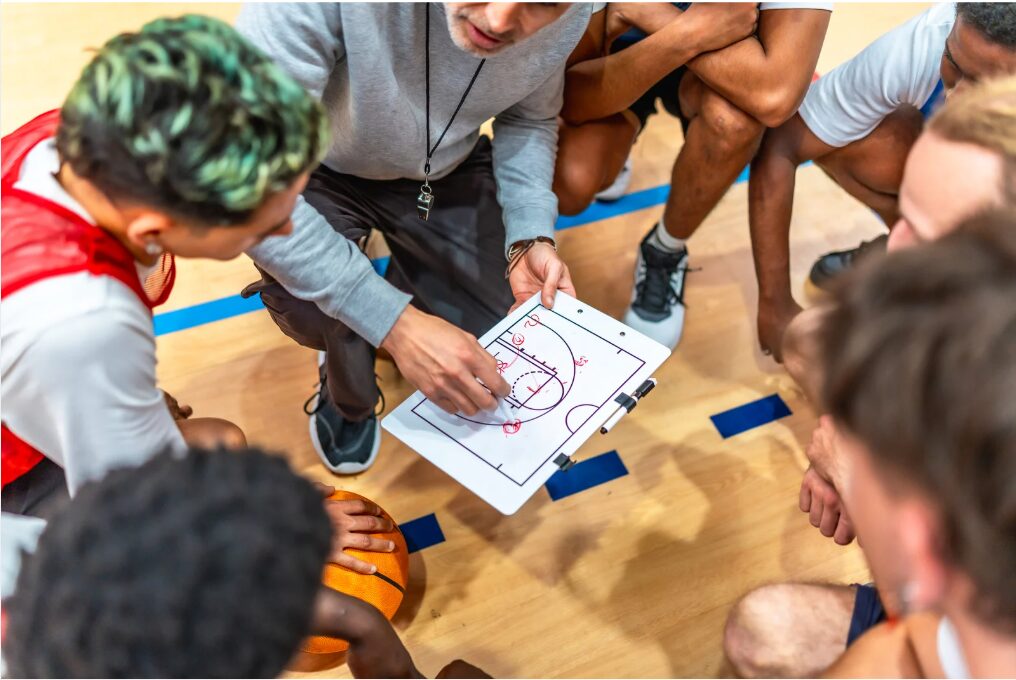
If you’re anything like me, you dream big. You think about how good the finish line is going to be, and you skip right past all the little details required to get there. That part’s not the fun part. The fun part is thinking about your dream — in my case, Sportoriety — leading to this big, beautiful life you’ve always wanted. But as they say, the devil is in the details.
I got a reminder of that this week. Not from my business. From my basketball team.
The Defense Told Us Everything
The other night, my kids played yet another team from Houston. This one was a better matchup for us than the last Houston team I wrote about in The Resilience of the Next Play: Lessons from a Basketball Blowout. Right out of the gate, they came out in a 2-3 zone — two guards up top covering the perimeter, three down low guarding the post and the corners.
Early on, our guards were cooking. Our bigs were not.
They weren’t flashing to the high and low post with an arm bar calling for the ball. On the rare occasions they did get a touch, they barely looked to score. They just kicked it right back out to the guards. The message to the other team was loud and clear: our bigs are not a threat.
So they switched to a 3-2 — three up top, two down low. At the 7th and 8th grade level, a 3-2 is a riskier defense. You’re putting a lot of pressure on the guards, and if they break past that front three, a short jumper or a layup is almost guaranteed. A 2-3 is usually the safer call at this age because kids aren’t shooting a high percentage from the perimeter yet.
But here’s the thing: the other team was willing to take that risk. Why? Because they’d figured out we had no inside game to punish them for it.
I Talked. I Didn’t Teach.
I spent the rest of the game imploring my bigs to get big. Be physical. Demand the ball. I told them the other team was pressuring the guards because they didn’t respect our post players as scorers.
I talked, and talked, and talked, and talked.
And then, after the game, it hit me. I didn’t teach. I was just talking.
I’ve been playing basketball for well over 30 years. Somewhere along the way, I started making the quiet assumption that things that feel simple to me must feel simple to the kids. I’ll teach a concept once or twice in practice, zoom back out to the plays and the defense, and expect the fundamentals to just be there when we need them in a game.
They weren’t there because I hadn’t put in the reps.
The kids wanted to do well. They were playing hard. Some of them are the best teammates on the team — coachable, supportive, all in. They didn’t fail me in that game. I failed them in the practices before it. You can’t master the motion of an offense without first mastering the fundamentals that make the motion work. And that’s on the coach, not the player.
The Hardest Part of Coaching Isn’t on Game Day
The blowout I wrote about last week was about helping my players control what they can control. This one is the mirror of that post. Because as a coach, I have to control what I can control too — and the biggest thing in that bucket is what we spend our time on in practice.
If my post players aren’t demanding the ball, that’s not a motivation problem. That’s a rep problem. And the only person who can fix a rep problem is the coach who runs practice.
The dream — the finish line, the deep tournament run, the kids who play the game the right way — doesn’t get built on the big stuff. It gets built on the boring stuff. Arm bars. Footwork. Flashing to the ball. The drills that aren’t fun to run but turn into the plays that win you games two months later.
As coaches, when our players don’t execute, the first place we should look isn’t the roster. It’s the practice plan.